
Construction’s Technology Renaissance pt. 2
Ubiquitous sensors, platforms, computer vision and abundant capital will usher in a new era of construction productivity

This is a continuation of the previous article on Construction’s Technology Renaissance. If you missed that, you can read it here (LINK).
Our third force for change in construction technology is venture capital.
Venture Capital, the Third Force
Venture capital (VC) is pouring into construction startups. According to McKinsey, VC in construction has outpaced investment in remaining verticals by 15x through 2019 (LINK). It should be noted that a significant amount of this money was raised for Katerra’s series D financing. Other firms, like Crunchbase, document the increase in deployed capital both in terms of number of deals and overall volume since 2013 (LINK). This signal all but confirms that investors are increasingly bullish on the space.
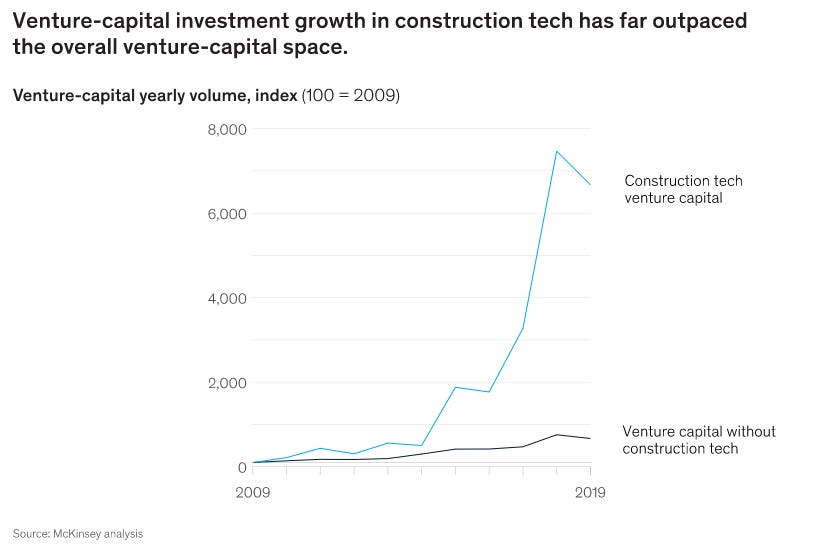
Big bets will hopefully accelerate development in construction technology. There are two feedback loops by which I think this will happen.
The first is based on efficacy. Deployed capital obviously helps the company that is raising financing, but it also helps the target market that it aims to service. If the target market enjoys real benefits from this new technology there may be greater inclination to try other new tools and technologies, accelerating further adoption and incentivizing venture capital to deploy even more capital.
The second is based on hype. As VC firms increasingly signal their support for the industry, they attract would-be entrepreneurs to enter the space and create their own technologies. As they gain traction, they attract investment themselves, leading back to the first feedback loop and hopefully promoting the ecosystem as a whole.
In fact, dedicated construction technology VC firms are emerging to capitalize on this trend. Brick Mortar VC raised $97M to invest solely into AEC startups. They are the largest dedicated VC fund in this space and have already invested in several related startups (LINK).
There is clearly investor demand for construction-related startups, but what does the other side of the coin look like? Here are some companies that have recently raised significant rounds.
Flo technologies (LINK)
Flo Technologies Inc., based in Culver City, completed a Series B fundraising round worth $28 million on Jan. 4, 2021 bringing the home water monitoring system developer’s total funding to an estimated $39.3 million.
“Flo by Moen consists of a Wi-Fi-enabled device that connects to a home’s water supply and sends smartphone alerts to the user if there is a leak, critical or small, in the system. A built-in Artificial Intelligence monitors temperature, pressure and water flow and automatically shuts the system off if a problem is detected.” (LINK)
Avvir (LINK)
Avvir, based in New York City, raised $10 million in a funding round led by Trust Ventures.
They use laser scans and AI to catch construction mistakes. “Customers send Avvir fabrication models and then deploy mobile lasers that can scan up to 30 square kilometers in an hour, even while construction is ongoing. Custom computer vision algorithms compare photographs and the scans with the building plans and catch errors and delays. Avvir claims it can identify construction problems like unlevel floors to one-eighth inch of accuracy.”
“Mistakes often prove to be costly in the construction industry. According to a study commissioned by Autodesk, 5% of construction professionals’ time is spent on nonproductive activities including looking for project information, conflict resolution, and dealing with errors and rework. It’s estimated that these activities cost the U.S. construction sector alone over $177 billion in labor in 2018.”
Avvir is a great example of the application of the fourth force that is going to transform the industry: computer vision.
Computer Vision, the Fourth Force
We know that sensors are a transformative force in the industry, but without the ability to understand the data they’re useless. Powerful and fast computer vision will be instrumental in turning visual information into actionable insights and will lead to substantial control over the site.
For the uninitiated, computer vision is a field of artificial intelligence (AI) that enables computers and systems to derive meaningful information from digital images, videos and other visual inputs.
On the construction site we know that there are issues with identifying progress, tracking productivity, and analyzing field work. Coupling computer vision and specific construction applications will allow for a detailed understanding of progress on site.
There are exciting companies doing this already.
Reconstruct uses laser scanning to identify where the as-built condition deviates from design. They can produce high fidelity time-based models of the project that help companies track productivity rates, identify deficiencies and can reconstruct a day by day progression of construction. It also creates a digital twin which can then be used in all remaining phases of the project.
As discussed, Avvir does something similar.
Both companies are incredibly disruptive in my opinion. They both offer construction companies (and their subcontractors) ways to insure against missing work, defective work, and incomplete work that costs significant time and money to rectify.
Besides mitigating downside, they have incredible upside in tracking production.
With computer vision, contractors and subcontractors can accurately track the amount of physical work produced on a daily basis. This means that managers have a better understanding of how the job is actually progressing. As an example, contractors won’t need to manually count the amount of precast panels installed on site to track progress. This also means that they have a better understanding if subcontractors' production rates will be sufficient to meet required deadlines. This helps de-risk the project for contractors and allows them to implement remediation measures before timelines have been missed.
All this to say computer vision is a huge piece of the puzzle that’s now being set in place. Hopefully in the near future, the learning curve will be steep enough, and the technology commonplace enough that every contractor will be able to track the progress of construction in real time, while building a digital twin.
As computer vision proliferates, project quality control will be substantially easier and projects themselves will be better and will require less retroactive repair.
In Closing
The future is certainly bright for construction technology and the construction firms that they will power. All four trends are converging to empower construction companies to do better work at lower costs. As technology firms scale and exit, the next generation of construction technology creators will be empowered to do the same, reinforcing the cycle and leading to even more productivity.
If you enjoyed the article, send it to a friend or leave a comment below.
Very Cool, Luigi!